
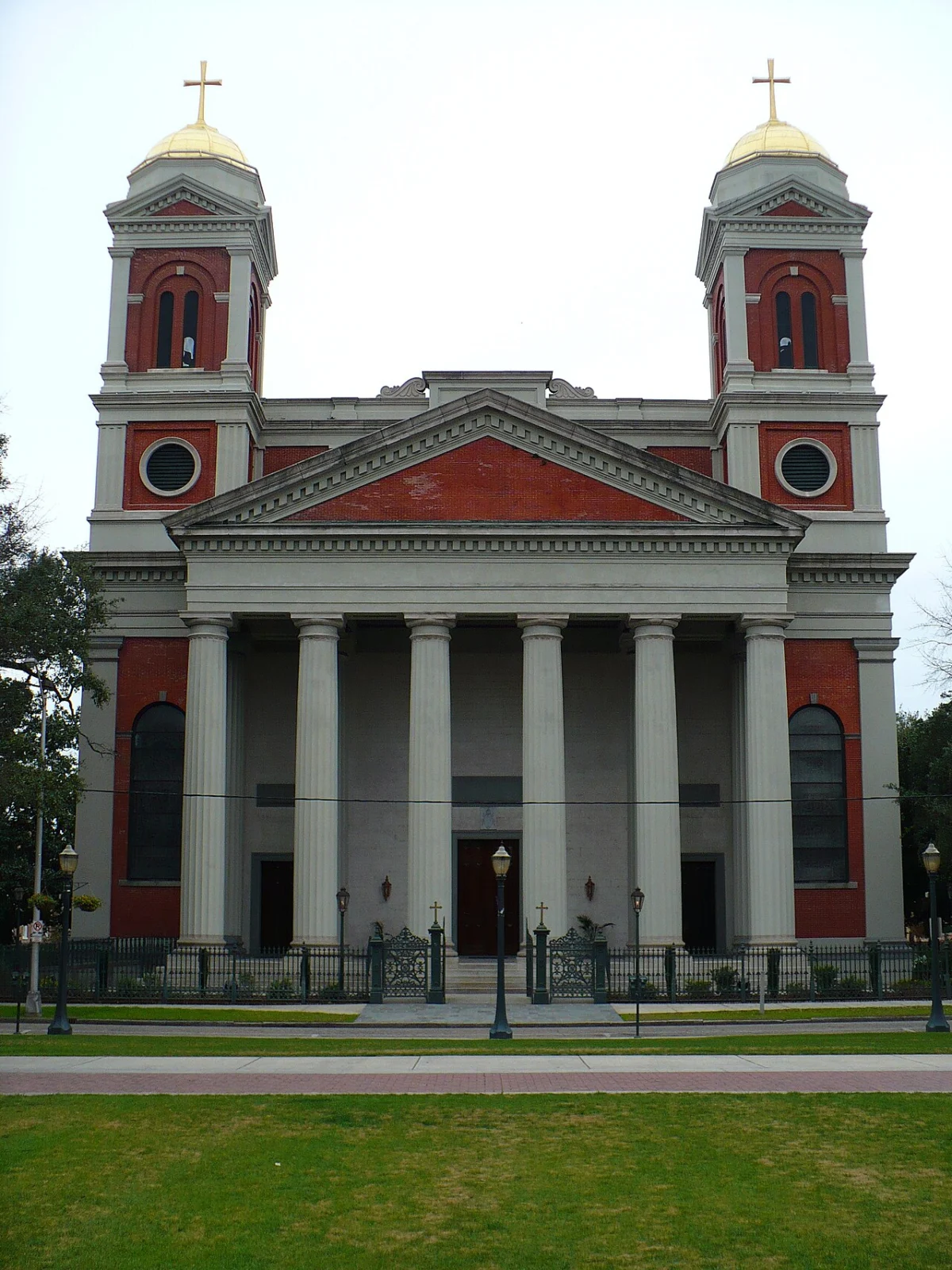
Photo: Altairisfar · Public domain · Wikimedia Commons
About
Walking through downtown Mobile, Alabama - an old port city on the Mobile River that flows into the Gulf of Mexico—one is stopped in one’s tracks at the corner of Dauphin and Claiborne Streets by a dignified building. Eight thick Doric columns support its portico, while two towers rise on either side, facing east toward the river. This is the Cathedral-Basilica of the Immaculate Conception. Beneath the unhurried southern sun, the cathedral stands as a quiet witness to the long history of Catholic faith in the region.
It is the cathedral church of the Archdiocese of Mobile, and its roots run remarkably deep. The parish began on July 20, 1703, when Bishop Saint-Vallier of Quebec established it. In 1829 Pope Pius VIII created the Diocese of Mobile and appointed Michael Portier as its first bishop, making this community the center of the new diocese. In 1962 Pope St. John XXIII elevated the church to the rank of minor basilica; the papal coat of arms still hangs above the main entrance as a mark of that honor.
Bishop Portier commissioned Claude Beroujon, a former seminarian and architect, to design a church in the style of a Roman basilica in 1833. The cornerstone was laid in 1835, but construction was long delayed by the economic panic of 1837. Finally completed in 1850, the cathedral was consecrated by Bishop Portier himself. Built of brick in the Greek Revival style, it measures approximately 164 feet in length and 90 feet in width. Lack of funds initially prevented the addition of the portico and towers; the portico was completed under Bishop Quinlan in the 1870s, and the two towers under Bishop O’Sullivan in 1884. The building is the fruit of patience sustained across generations of bishops and faithful. Standing beneath the ceiling that rises some 60 feet, one feels both the restraint and the generosity of classical proportions. The twin towers, each about 103 feet high, still rise above the old streets of downtown Mobile.
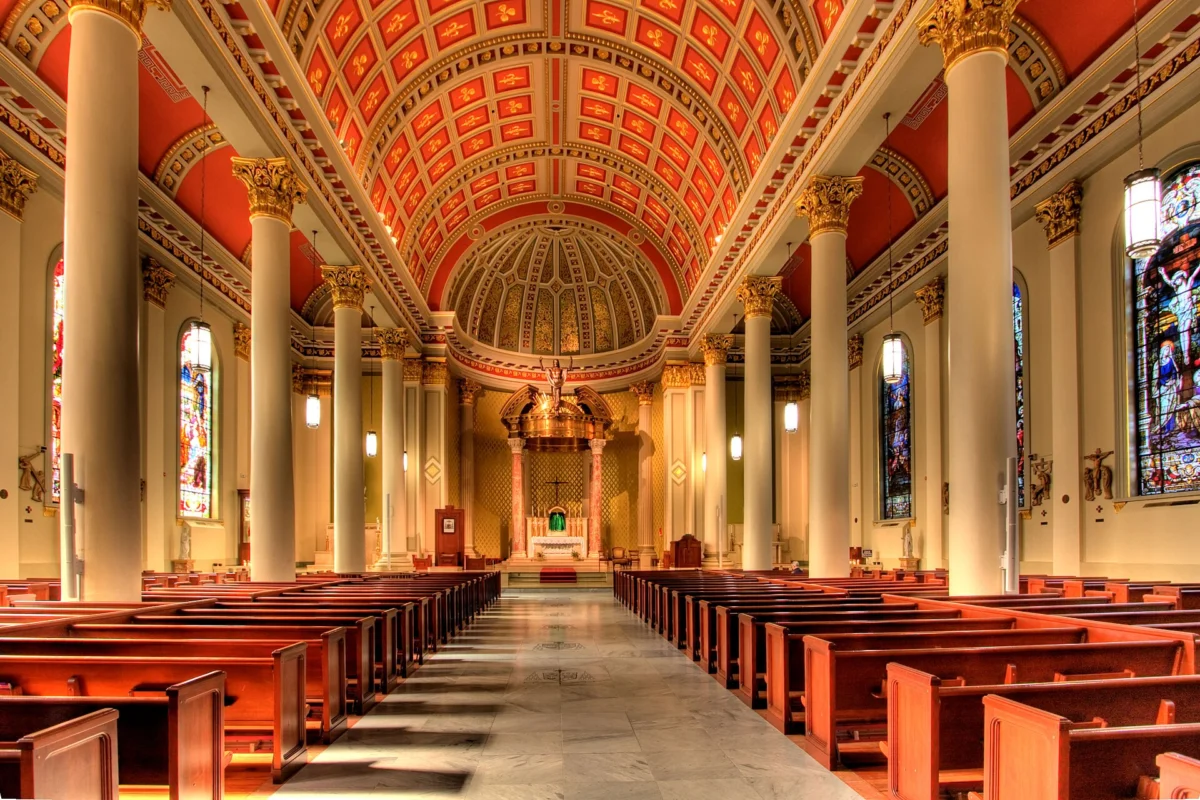
Inside, the stained-glass windows immediately draw the eye. Twelve large windows, each roughly 8 feet wide and 23 feet high, were made between 1890 and 1910 by the Franz Mayer studio of Munich, Germany. Each window depicts a scene from the life of the Blessed Virgin Mary with Jesus. Above the altar stands a bronze baldachin supported by four marble columns, crowned by a statue of the Risen Christ. During the restoration of the 2000s, a gilded coffered ceiling, marble floors, and the coats of arms of successive bishops set into the pavement were added; a mural of the Tree of Jesse was painted above the organ.
The cathedral has also endured many trials. In 1865 an explosion at a nearby munitions depot shattered the north windows. In 1946 a Navy plane struck the south tower. On March 19, 1954—the Feast of St. Joseph—a major fire severely damaged the interior and destroyed eight of the stained-glass windows. Firefighters entered the flames to rescue sacred objects, and the building itself did not collapse. The faithful later replaced the windows and renovated the interior. Even after Hurricane Frederic damaged the steeples in 1979, the cathedral rose again.
Viewed through the eyes of a Korean-American Catholic, the cathedral’s history of falling and rising again lingers in the heart. It echoes the experience of immigrant churches that, despite hardships in a foreign land, have held fast to the faith and preserved their communities. That this church has been dedicated to the Immaculate Conception through all those centuries brings a special comfort to Korean Catholics, who have long held a particular devotion to the Blessed Mother.
If you travel through the American South, I recommend stopping at this venerable cathedral in Mobile. You might follow the scenes of Our Lady’s life in the stained glass while praying a decade of the Rosary. Mass times and visitor information can be found on the cathedral’s official website. Before leaving, pause a moment to look back at the papal coat of arms above the main door and the twin towers rising above, and remember the many who have cared for this place. In this house of faith that has stood for more than three centuries, you may find a quiet and profound peace.
It is the cathedral church of the Archdiocese of Mobile, and its roots run remarkably deep. The parish began on July 20, 1703, when Bishop Saint-Vallier of Quebec established it. In 1829 Pope Pius VIII created the Diocese of Mobile and appointed Michael Portier as its first bishop, making this community the center of the new diocese. In 1962 Pope St. John XXIII elevated the church to the rank of minor basilica; the papal coat of arms still hangs above the main entrance as a mark of that honor.
Bishop Portier commissioned Claude Beroujon, a former seminarian and architect, to design a church in the style of a Roman basilica in 1833. The cornerstone was laid in 1835, but construction was long delayed by the economic panic of 1837. Finally completed in 1850, the cathedral was consecrated by Bishop Portier himself. Built of brick in the Greek Revival style, it measures approximately 164 feet in length and 90 feet in width. Lack of funds initially prevented the addition of the portico and towers; the portico was completed under Bishop Quinlan in the 1870s, and the two towers under Bishop O’Sullivan in 1884. The building is the fruit of patience sustained across generations of bishops and faithful. Standing beneath the ceiling that rises some 60 feet, one feels both the restraint and the generosity of classical proportions. The twin towers, each about 103 feet high, still rise above the old streets of downtown Mobile.
Inside, the stained-glass windows immediately draw the eye. Twelve large windows, each roughly 8 feet wide and 23 feet high, were made between 1890 and 1910 by the Franz Mayer studio of Munich, Germany. Each window depicts a scene from the life of the Blessed Virgin Mary with Jesus. Above the altar stands a bronze baldachin supported by four marble columns, crowned by a statue of the Risen Christ. During the restoration of the 2000s, a gilded coffered ceiling, marble floors, and the coats of arms of successive bishops set into the pavement were added; a mural of the Tree of Jesse was painted above the organ.
The cathedral has also endured many trials. In 1865 an explosion at a nearby munitions depot shattered the north windows. In 1946 a Navy plane struck the south tower. On March 19, 1954—the Feast of St. Joseph—a major fire severely damaged the interior and destroyed eight of the stained-glass windows. Firefighters entered the flames to rescue sacred objects, and the building itself did not collapse. The faithful later replaced the windows and renovated the interior. Even after Hurricane Frederic damaged the steeples in 1979, the cathedral rose again.
Viewed through the eyes of a Korean-American Catholic, the cathedral’s history of falling and rising again lingers in the heart. It echoes the experience of immigrant churches that, despite hardships in a foreign land, have held fast to the faith and preserved their communities. That this church has been dedicated to the Immaculate Conception through all those centuries brings a special comfort to Korean Catholics, who have long held a particular devotion to the Blessed Mother.
If you travel through the American South, I recommend stopping at this venerable cathedral in Mobile. You might follow the scenes of Our Lady’s life in the stained glass while praying a decade of the Rosary. Mass times and visitor information can be found on the cathedral’s official website. Before leaving, pause a moment to look back at the papal coat of arms above the main door and the twin towers rising above, and remember the many who have cared for this place. In this house of faith that has stood for more than three centuries, you may find a quiet and profound peace.
Photos
Cathedral
Cathedral-Basilica of the Immaculate Conception
원죄 없이 잉태되신 성모 대성당